Zenstate

#AI #FIGMA #FIREBASE

zenstate
Role

UX/UI Designer,

Frontend Developer,

Document Controller

Tools

Figma, Firebase, Flutter

Timeline

Autumn 2025

2 months, 50%

Overview

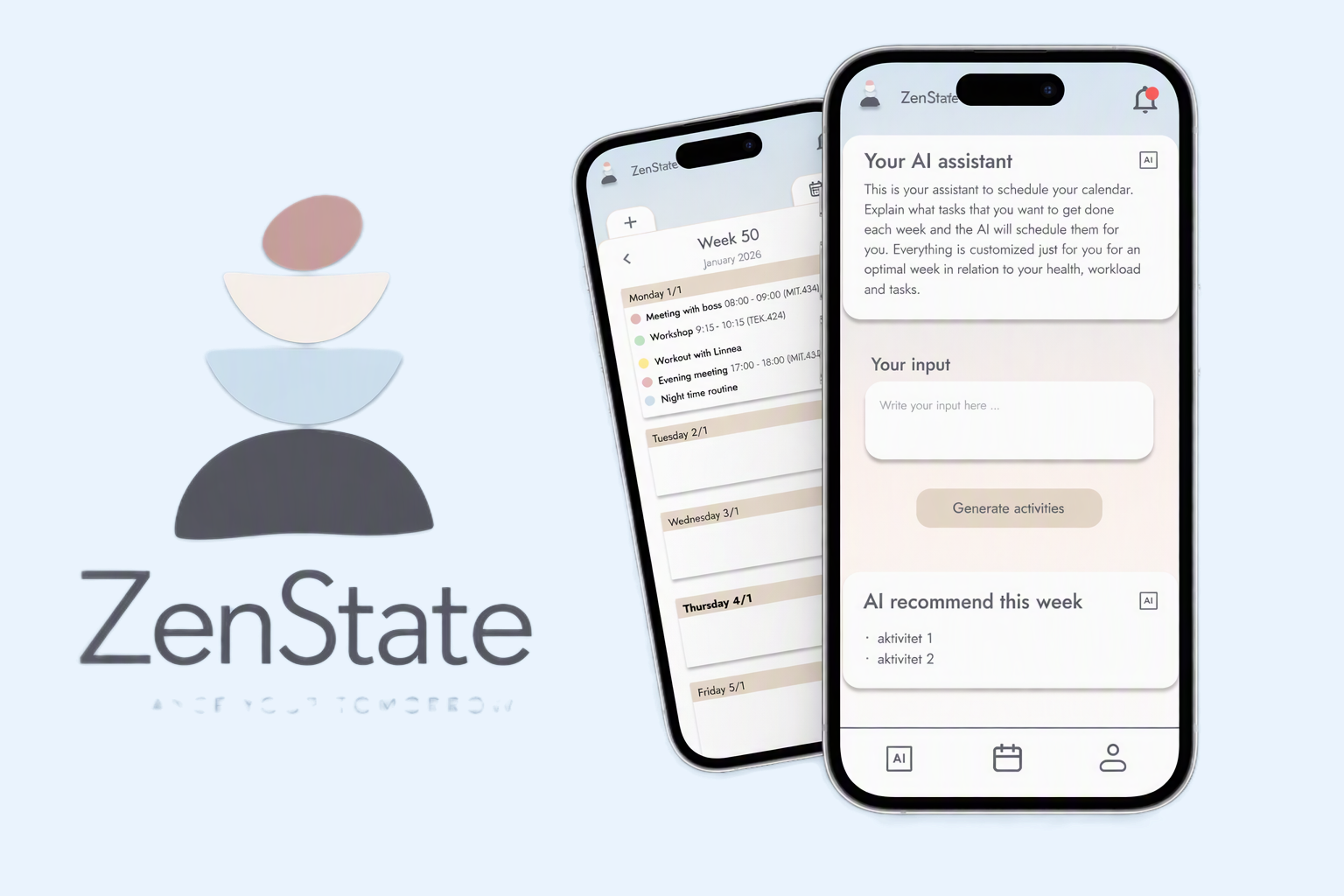
ZenState is a mobile calendar concept designed to help people who experience stress create a more balanced everyday life. The concept combines personal calendar data, health data from wearable technology and AI-generated activity suggestions to create a more personalized planning experience.

Instead of treating the calendar as a static list of events, ZenState uses information about the user's physical state to suggest activities that fit their current energy levels and schedule. The goal was to explore how data from wearable technology could be used to create a more supportive and human-centred planning tool.

The project was developed as part of the course Innovative Mobile Services and Systems, in collaboration with Knightec. Our team explored the concept from early ideation and user testing through UX/UI design and implementation.

The final prototype was developed using Flutter, Firebase and AI services, with a focus on creating a calm, accessible and intuitive experience.
Process

The project followed an iterative design and development process where we continuously tested, evaluated and refined the concept. The team worked in parallel across design and development while regularly discussing decisions and improvements.

Idea & Concept

We started by exploring how data from wearable technology could be used in new types of mobile services. From this exploration, we identified an opportunity to combine health data with everyday planning. The initial concept was a calendar that could understand more than just what a user had scheduled. By connecting calendar events with information such as sleep, steps, calories and resting heart rate, the application could provide suggestions based on the user's current state.

Visual Design Choices

Zenstate design

LoFi/HiFi-prototyping & User Testing

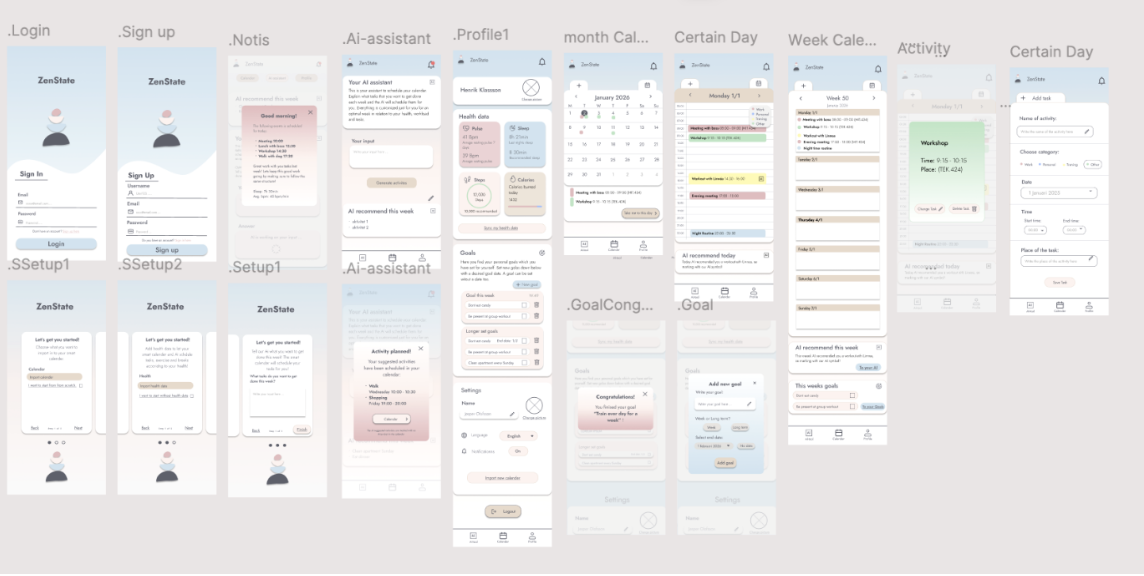
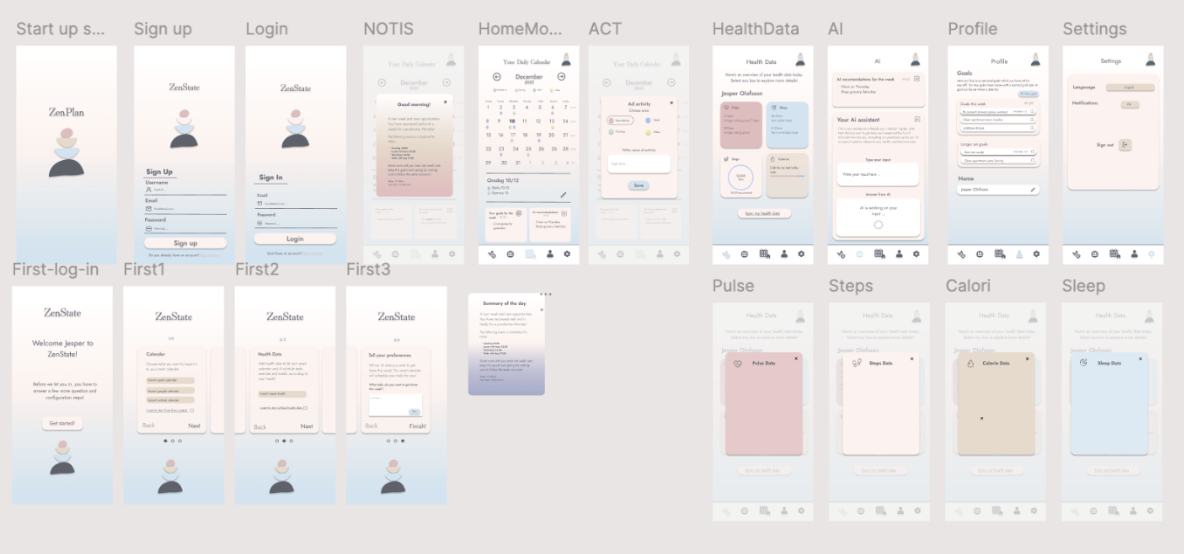
The design team created two separate lo-fi prototypes, which were tested using A/B testing and scenario-based testing with six participants. The testing helped us understand how users wanted to interact with their calendar and which information was most important. One clear insight was the need for a simple monthly overview and an easy way to add activities. Based on the feedback, we combined the strongest elements from both prototypes into a shared lo-fi concept.

zenstate lofi

HiFi-prototype

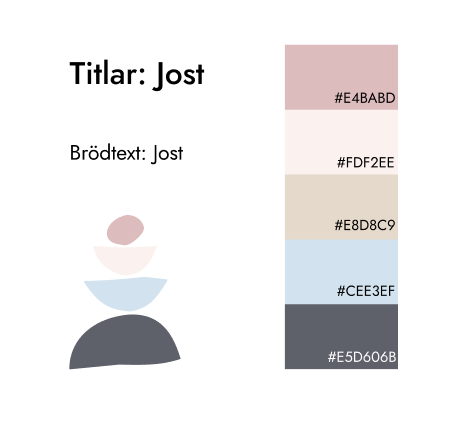
The combined concept was developed into a hi-fi prototype in Figma. We focused on creating a calm and accessible visual identity that would feel appropriate for users experiencing stress. The visual language uses soft colours, rounded shapes and the Jost typeface to create a simple and harmonious interface. We also reduced the navigation to three main areas to make the application easier to understand. The calendar was designed to support different levels of planning, allowing users to switch between month, week and day views. The hi-fi prototype was tested with four participants. Their feedback led to further adjustments to typography, contrast, navigation and the overall hierarchy of the interface.

Umecatch design process

Development

In parallel with the design process, the development team created the application structure, Firebase database and the foundation for the AI functionality. The application was developed using Flutter and connected to Firebase for authentication and data storage. Health data was accessed through HealthKit, while the device calendar was integrated through the device_calendar library. A key part of the development was the AI planning assistant. The assistant gathers information such as upcoming calendar events, health data and the user's request, and uses this context to generate personalized activity suggestions. The AI was implemented using the Groq inference platform and the openai/gpt-oss-120b model. The generated suggestions could then be converted into calendar events and added to the user's schedule. The final prototype was tested again using scenario-based tasks to evaluate the implemented experience and identify remaining issues.

Final Result

The final result is a functional mobile prototype that combines calendar planning, health data and AI-assisted scheduling into one experience.

ZenState allows users to connect their calendar and health data, view their schedule and receive personalized suggestions from the AI assistant. The application can consider information such as sleep, steps, calories and resting heart rate when generating recommendations.

The prototype includes onboarding, calendar views, notifications, health status, goals, profile functionality and an AI assistant. The calendar supports different views and allows users to create, edit and remove activities.

One of the key features is the AI planning assistant. Instead of simply generating generic suggestions, the assistant considers the user's existing schedule and available health data. It can suggest activities at suitable times while avoiding conflicts and allowing time between activities.

The implemented prototype reached approximately 85% of the intended hi-fi design. The core functionality was implemented, including calendar integration, health data integration, notifications, Firebase synchronization and AI-assisted planning. Some visual details and the complete calendar experience remained to be refined.

The project showed the potential of combining wearable data with everyday planning. With more development time, we would have focused on completing the full hi-fi implementation, improving the AI's contextual understanding and conducting more extensive testing with the intended target audience.

Future development could also include more personalized recommendations, improved AI performance and a more clearly defined target group or healthcare-related use case.

Let’s talk

elin.soderstrom@live.se
← Back to projects